The proliferation of Unmanned Aerial Vehicles (UAVs), or drones, in military applications has expanded over the past decade. Initially utilised for reconnaissance, drones now perform precision airstrikes and close air support. The world at large has embraced the use and production of autonomous and unmanned drones.
EDGE Group, one of the world’s leading advanced technology groups, headquartered in Abu Dhabi, has a strong focus on UAVs, and has developed a number of advanced UAV systems for military applications. ADASI and HALCON, entities of EDGE Group, possess in-depth expertise in the UAV sector. Their systems range from advanced unmanned systems to Artificial Intelligence (AI)-enabled drones. Let us have a look at some of the UAVs developed by these two companies.
Types of Drones
UAVs are commonly differentiated by their propulsion system and airframe. The four basic types are fixed-wing, rotary-wing/single-rotor, multirotor, and vertical take-off and landing (VTOL).
Fixed-wing UAVs
A fixed-wing aircraft is a heavier-than-air flying machine that achieves flight through wings generating lift from forward airspeed and wing shape. Propulsion systems typically involve fuel or electric propeller engines, or jet engines.
HUNTER 5 — Electric & Flexible Drone
The HALCON HUNTER 5, is a fixed-wing, propeller engine UAV. It has a take-off weight of 50kg and can be launched from the rear of an armoured vehicle. It carries a 5kg payload, reaches a maximum altitude of 7,000ft, and is well suited for reconnaissance and attack missions. Operating at a cruising speed of 120km/h, it maintains a flight endurance of 30 minutes.
SHADOW 25 - Jet Powered Loitering Unmanned Aerial Vehicle
The SHADOW 25, a HALCON product, represents a fixed-wing, turbojet-powered UAV. This loitering system swiftly targets stationary enemies, featuring a 400 km/h cruising speed, 25kg payload, and up to 250 km strike range. Guided by advanced technology, including video navigation, it’s a precise and potent weapon.
Rotary-wing/ Single-rotor UAVs
A single-rotor/rotary-wing UAV, similar to a helicopter, is a type of drone that is a heavier-than-air aircraft with rotary blades that generate lift by rotating around a vertical mast. This type of UAV is able to hover and fly in confined spaces. It is a valuable asset for defence forces, as it provides them with a highly capable weapon system that can be used to neutralise a variety of targets.
GARMOOSHA - Light Unmanned VTOL
The GARMOOSHA, is a rotary-wing UAV characterised by its impressive capabilities. It has a maximum take-off weight of 550 kg and can carry payloads of around 120 kg while maintaining an eight-hour endurance and covering a range of 150 km. This helicopter design prioritises surveillance capacities, enabling military forces to preserve manned helicopters for vital operations.
Multirotor UAVs
A multirotor drone is a variant featuring more than two rotors that generate lift.
QX-3 Loitering Munition
The ADASI QX-3 is a multirotor UAV, also serving as a loitering munitions system. Weighing 20 kg, it equips infantry and special forces with a potent aerial advantage, carrying up to four precision-guided munitions. With onboard video and advanced communication systems, the platform empowers operators to respond to changing realities in real time, providing robust support to ground operations. Transportable by a light vehicle, the system offers a stand-off range of 40 km and an endurance of up to 40 minutes for extended mission scenarios.
Vertical Take-Off and Landing UAVs
The first vertical take-off and landing (VTOL) aircraft was invented in 1958, but designs were largely impractical until recent decades. VTOL aircraft can hover, take off, and land vertically without relying on a runway. VTOL aircraft, like helicopters, employ fixed-wing and rotary-wing principles for flight, enabling vertical take-off and landing.
QX-5 VTOL
The ADASI QX-5 is a modern VTOL UAV for advanced intelligence, surveillance & reconnaissance (ISR) missions, with up to 16 hours of endurance. It carries payloads up to 25 kg, offering multiple mission scenarios to border control and military forces. With a range of up to 150 km and a maximum altitude of 15,000ft, the QX-5 is the ideal vehicle to accomplish high-priority operations.
Categories of Drones
Military drone classifications vary according to factors such as size, range, endurance, weight, altitude, and autonomy level. Weight-based categorisation divides UAVs into five primary groups. Nano UAVs, at under 250g, are exceptionally compact, lightweight, and often launched by hand. Primarily utilised for close ground situational awareness within confined areas, their range, speed, and altitude capabilities are restricted. Micro UAVs, also known as Micro Air Vehicles (MAVs), fall within the 250g to 2kg weight range. MAVs aren’t presently employed by militaries due to practical constraints, as ground control pilots can’t maintain visual contact beyond 100 metres and on-board transmitters lack the power for effective teleoperation.
Small UAVs (SUAVs) weigh between 2-25kg and find use in mainly Special Forces operations. Capable of carrying a payload, SUAVs can conduct ISR missions, and strike a target. Hand-held and man portable are usual characteristics of this type of drone. Medium UAVs weigh between 25-150kg and are typically fixed-wing. This type of UAV has more advanced strike capabilities, with a longer range and endurance than SUAVs for ISR missions.
EDGE Group has a range of UAVs that fall under this type of UAV.
Large UAVs, weighing over 150kg, include medium-altitude, long-endurance (MALE) and high-altitude, long-endurance (HALE) types. These drones are valued by militaries for their extended range, endurance, and capability to engage targets from afar with substantial payloads.
Holding the Edge
EDGE’s UAVs possess distinct advantages that set them apart. Among some of them are:
HUNTER HAND LAUNCHED DRONE
The HUNTER HAND-LAUNCHED DRONE possesses a take-off weight of just 2kg and can be placed into fight by hand. It falls under the SUAV category and is rotary-wing type. The drone carries a payload of 400g, flying at a maximum altitude of 500m. It operates at a cruising speed of 46km/h, is 200mm in length, and features twin rotary blades spanning approximately 500mm, which run off an electric engine. The HUNTER has a flight endurance of 30 minutes.
HUNTER SP
The HALCON HUNTER SOLDIER PORTABLE tube-launched UAV is an SUAV that has a take-off weight of 4.5kg and can be launched from a portable launcher. It carries a payload of 700g, flying at a maximum altitude of 1000ft. The drone is suitable for reconnaissance and attack missions, operating at a cruising speed of 90km/h, with an endurance of 20 minutes.

HUNTER 10
The HALCON HUNTER 10 is a tube-launched tactical medium UAV, designed for reconnaissance and attack missions. It has a take-off weight of 50kg and can be fired from the back of an armoured or artillery vehicle. The drone has a wingspan of 3.6m, a length of 2.85m, and is powered by an electric engine. It carries a payload of 10kg, flying at a maximum altitude of 7,000ft.
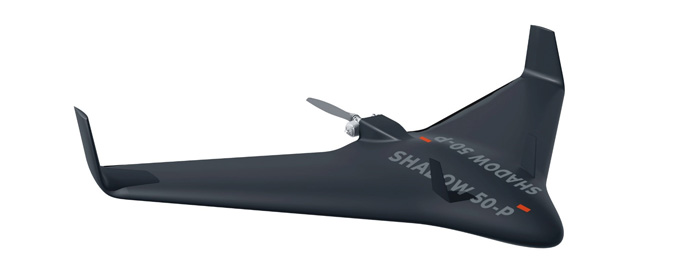
SHADOW 50-P
Weighing 135kg, the ADASI SHADOW 50-P loitering UAV system falls under medium UAVs. It is a fixed-wing, propeller engine UAV that provides defence forces with a powerful, long-endurance, loitering munition that delivers precision strike capabilities against fixed targets.
Featuring advanced guidance capabilities and onboard video navigation, it enables the rapid delivery of large payloads up to 50kg, while offering mission flexibility with up to 295km range and nine hours endurance.
REACH-S
The HALCON REACH-S is a medium-altitude, long-endurance (MALE) fixed-wing drone possessing a take-off weight of 600kg. REACH-S falls under the Large UAV category and can carry a payload of up to 120kg. It can attain altitude of 19,000ft, reaching a cruising speed of 149km/h. The drone has a wingspan of 12m and a length of 5.5m. REACH-S has a communications range of 200km.
Future of Military UAVs
The future of military UAVs relies on AI. Drones with autonomy, target recognition, and decision-making like HUNTER 2-S are set to transform aerial operations. These swarming drones use AI for coordinated missions, target recognition, and task assignment within the swarm.
HUNTER 2-S
The HALCON HUNTER 2-S is an AI-equipped fixed-wing, ground-launched tactical swarming drone. Sharing data among other drones in the swarm, it coordinates missions effectively. Carrying up to 2kg payloads, these ground-launched swarming drones are suitable for reconnaissance or strike missions and can reach a maximum altitude of 3,000ft, with a cruising speed of 90 km/h for 30 minutes. With a 2.2m wingspan and 1.5m length, it runs on an electric engine.
Drone Dynamics
UAVs exemplify tech innovation, from nano drones to AI-driven swarms like the HUNTER 2-S, reshaping tactics.
Propelled by leaders like EDGE Group, they promise coordinate autonomy, reshaping conflicts.















No Comments