2023-04-01
Northrop Connects Platforms across Air, Sea Domains
Northrop Grumman Corporation has used a Triton platform to successfully demonstrate its gateway technology that proved the ability to connect airborne platforms with naval assets.
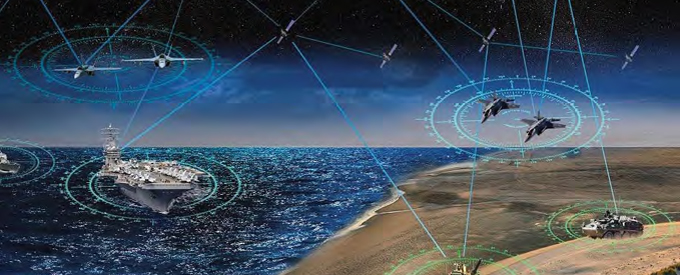
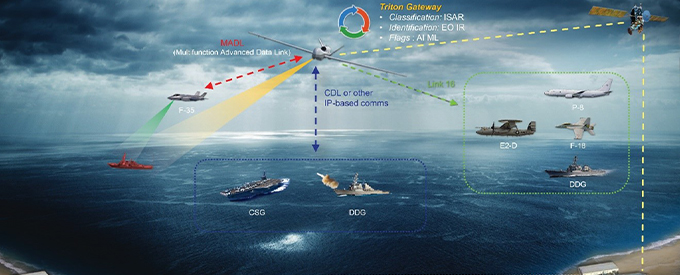
The multi-platform demonstration showcased interoperability among F-35, MQ-4C Triton, E-2D Advanced Hawkeye and naval ships.
The first-of-its-kind demonstration was conducted with Naval Air Systems Command, Office of Naval Research, Naval Information Warfare Center Pacific and BAE Systems.
The multi-domain capability on the Triton platform bolsters the Navy’s interoperability to help enable distributed maritime operations.
Equipped on Northrop Grumman’s MQ-4C Triton Flying Test Bed, the airborne gateway shared fifth-generation sensor data to ground-based simulators that represented an F-35, an E-2D Advanced Hawkeye, U.S. Navy Aegis class destroyers and carrier strike groups.
The gateway integrated with Triton’s radar and artificial intelligence and machine learning capabilities to significantly enhance situational awareness across previously disconnected platforms.
The addition of the gateway on Triton expands data sharing and will improve the warfighter’s ability to stay ahead of the adversary and make decisions faster across a vast and diverse environment.
Ben Davies, vice president and general manager, network information solutions, Northrop Grumman, explained: “Our gateways provide an open, secure and resilient solution needed to enable information advantage for our customers. This powerful combination expands the mission sets of maritime platforms to deliver a seamlessly connected fleet — a critical step as the U.S. Navy achieves its naval operational architecture to enable distributed maritime operations.”
Jane Bishop, vice president and general manager, global surveillance, Northrop Grumman, added: “Triton’s altitude, persistence, and robust communication links make it an ideal candidate to host the gateway system. The demonstration highlighted gateway technology enhancements to Triton that would enable information dominance across distributed maritime assets, including access to the F-35’s robust sensor suite and the E-2D’s battle management capabilities.”
JADC2 Connectivity
Last year, Northrop Grumman Corporation collaborated with Cubic Mission and Performance Solutions (CMPS), a division of Cubic Corporation, to demonstrate a High Capacity Backbone (HCB)-enabled Gateway System solution that provides foundational connectivity and processing capabilities to enable Joint All Domain Command and Control (JADC2) and ensure delivery of the right data, to the right place, at the right time.
In a recent demonstration, Northrop Grumman and Cubic showcased an interconnected, vendor-agnostic network through Open Mission Systems (OMS) interfaces, proving the ability to deliver enhanced all domain command and control capabilities to fifth and fourth generation platforms.
The company connected disparate systems that will enable interoperability to help the Department of Defence achieve their JADC2 vision. The demonstration showcased technologies and solution sets that are critical enablers for JADC2.
Incorporating PlatformONE, GatewayONE and Northrop Grumman’s Resilient Network Controller, the company demonstrated rapid technology insertion and network management, recovery and optimisation in a contested environment. These solution sets showed how quickly new technology could be deployed to the tactical edge utilising containerised software architecture.
Cubic has planned a complex air/ground flight test event soon. The development of Cubic’s Halo Software Defined Antenna, utilises novel digital beam forming techniques to enable an ad hoc directional mesh for problem sets like JADC2. The modular, building-block approach will allow the system to be integrated on a variety of platforms enabling secure data transport into and out of highly contested environments.
Triton’s Sensor Suite
Based on the proven Global Hawk unmanned aerial vehicle (UAS), Triton’s autonomous operations are supported by land-based command and control mission planners and sensor operators. Triton will be equipped with a unique and robust mission sensor suite that provides 360-degree coverage on all sensors, providing unprecedented maritime domain awareness for the U.S. Navy.
Triton also incorporates a reinforced airframe, for increased internal payload, and wing for hail, bird strike, and gust load protection, along with de-icing and lightning protection systems. These features allow the aircraft to descend and ascend through harsh maritime weather environments to gain a closer view of ships and other targets at sea when needed.
Built for the U.S. Navy, Triton will support a wide range of missions including maritime Intelligence, surveillance, and reconnaissance (ISR) patrol, signals intelligence, search and rescue and communications relay.
The aircraft can fly over 24 hours at a time, at altitudes higher than 10 miles, with an operational range of 8,200 nautical miles.


















No Comments