2020-09-01
Boeing X-37B Team Wins Collier Trophy for Aerospace Excellence
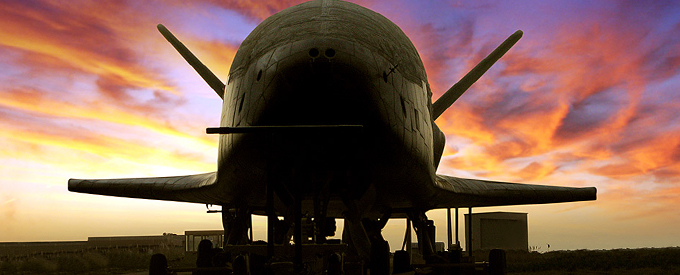
The U.S. Department of the Air Force and Boeing X-37B autonomous spaceplane team has won the prestigious Robert J. Collier Trophy for the greatest American achievements in aeronautics and astronautics of 2019. The X-37B set a new 780-day on-orbit endurance record and completed an overflight of the United States, using Federal Aviation Administration airspace, before making a pinpoint landing at NASA’s Kennedy Space Center.
The National Aeronautic Association is awarding the 2019 Collier to the X-37B for advancing the performance, efficiency and safety of air and space vehicles.
Designed and built by Boeing, operated in partnership with the U.S. Space Force, and managed by the U.S. Department of the Air Force Rapid Capabilities Office, the X-37B is a reliable, reusable, uncrewed space test platform designed to carry experiments to orbit and return them to Earth for evaluation.
“Underscoring the importance of space to the nation, the Collier Trophy celebrates the record-setting mission of the X-37B,” said Secretary of the Air Force Barbara Barrett. “Most Americans use space daily for navigation, information, and communication. Sophisticated and uncrewed, the X-37B advances reusable spaceplane technologies and operates experiments in space that are returned for further examination on Earth.”
In addition, Boeing facilitates the integration of experiments into the X-37B system and helps identify future reusable-platform experiment opportunities for each mission. X-37B is the 33rd Boeing effort to receive a Collier.
“We are truly honoured that the women and men of the X-37B team are being recognised with the Collier Trophy,” said Boeing Defense, Space & Security President and CEO Leanne Caret. “Not only have they earned a place among our industry’s legends through their commitment to innovation and performance, but their accomplishments will influence the next generation of space and aerospace development for the benefit of all humanity.”
First awarded in 1911, the trophy’s past recipients include Orville Wright; the Apollo 11 lunar landing team; the International Space Station, built by Boeing for NASA; the F/A-18E/F Super Hornet, built by Boeing for the US Navy; and the Boeing 787, 777 and 747 commercial airplanes.
The Newest and Most Advanced Re-Entry Spacecraft
The X-37B Orbital Test Vehicle, or OTV, is an experimental test programme to demonstrate technologies for a reliable, reusable, unmanned space test platform for the U.S. Air Force.
It is the newest and most advanced re-entry spacecraft. Based on NASA’s X-37 design, the unmanned OTV is designed for vertical launch to low Earth orbit altitudes where it can perform long duration space technology experimentation and testing. Upon command from the ground, the OTV autonomously re-enters the atmosphere, descends, and lands horizontally on a runway.
Technologies being tested in the programme include advanced guidance, navigation and control, thermal protection systems, avionics, high temperature structures and seals, conformal reusable insulation, lightweight electromechanical flight systems, advanced propulsion systems, advanced materials and autonomous orbital flight, reentry and landing.
A Vehicle That Set Endurance Records in Each of Five Flights
The Department of the U.S. Air Force Rapid Capabilities Office is leading the Defence Department’s Orbital Test Vehicle initiative, by direction of the undersecretary of defence for acquisition, technology and logistics and the secretary of the Air Force. The Air Force OTV effort uses extensive contractor and government investments in the X-37 programme by the Air Force, NASA and the Defence Advanced Research Projects Agency (DARPA) to continue full-scale development and on-orbit testing of a long-duration, reusable space vehicle.
NASA’s original X-37 programme began in 1999 and was transferred to DARPA in 2004. NASA envisioned building two vehicles, an Approach and Landing Test Vehicle, or ALTV, and an Orbital Vehicle. DARPA completed the ALTV portion of the X-37 programme in 2006.
It successfully extended the flight envelope beyond the low speed/low altitude tests previously conducted by NASA on the X-40A, a sub-scale version of the X-37 developed by Air Force Research Labs. NASA’s X-37 Orbital Vehicle was never built, but its design was the starting point for the Air Force’s X-37B Orbital Test Vehicle programme.
The Air Force has successfully flown five X-37B missions, OTV-1 through OTV-5. In 2019, the spaceplane broke its own on-orbit endurance record of 718 days. This is the ninth Collier Trophy shared by the U.S. Department of the Air Force and its forerunners, and Boeing and its legacy companies.

















No Comments