2021-11-03
Raytheon Radars Keep Missiles at Bay
Growing threats from missiles call for stronger defence through radars. A ballistic missile attack, for example, can be chaotic. In a raid scenario, dozens of these weapons can approach from all directions, travelling at supersonic and even hypersonic speeds. Compounding the challenge, adversaries can mask them, making them look like something else, even while using electronic warfare to trick the target’s defences.
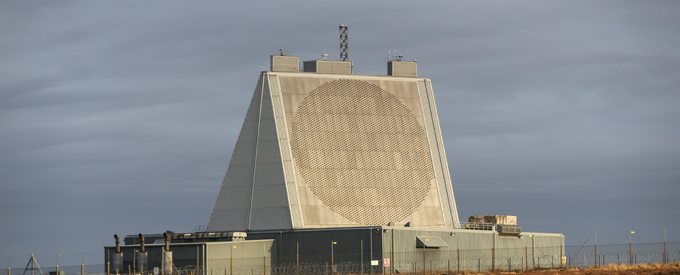
Stopping those attacks is no easy task, and it all starts with a powerful radar. Or, in this case, two: the AN/FPS-132 Upgraded Early Warning Radar (UEWR), which casts a wide-area net, and the Army Navy/ Transportable Radar Surveillance and Control Model 2 (AN/TPY-2) Radar, which delivers the most precise discrimination possible. Both are built by Raytheon Missiles & Defense, a Raytheon Technologies business.
Joe Preiss, technical director for the Strategic Missile Defense area of Raytheon Missiles & Defense, a business of Raytheon Technologies, explained: “They work very well independently. That’s been proven over many years. What we’re talking about now is a tight coupling of these two radars. Using both radars takes full advantage of the differences in them in terms of where and how they detect objects. That combination delivers robust detection and resilience, particularly in environments where there may be issues in seeing and identifying the threat.”
“The numbers of missiles are increasing substantially and are becoming more sophisticated,” asserted Bill Marcley, senior director of sensors and systems in the Air Power area of Raytheon Missiles & Defense. “So, you need radars that are operational and sensing all the time, capable of handling many threatening tracks at various ranges.”
That’s especially critical when an adversary can mask missiles or make them look like something else at the same time as they’re trying to desensitise your radar with electronic warfare. All this, even as the attacker is sending a large raid size of ballistic missiles your way. How do you stop these threats in their tracks promptly and accurately?
All Day, Every Day
One of the biggest challenges posed by ballistic missile attacks is that they can come from anywhere—from land, air, sea and even from submarines. Some stay within Earth’s atmosphere. Others hurtle through space. What it all means is that defensive radars must keep 360-degree watch all day, every day.
UEWR and AN/TPY-2 cover the entire field. These radars are like teammates in a soccer match, both available and ready to stop the opponent from advancing.
UEWR uses the ultra-high frequency band, or UHF, and has the longer range of the two, with the ability to track missiles beyond 5,000 km—outside the atmosphere and, importantly, far from wherever the attack is headed. It provides early detection and precise tracking of incoming attacks, and it also classifies space objects, meaning it can distinguish quickly between a threat and a non-threat. That’s why it’s known as “the big eye, always watching.”
AN/TPY-2 operates in the X-band of the electromagnetic spectrum and, at closer range, it detects, tracks and discriminates ballistic missiles as they rise and descend. This radar’s use of the X-band, with its shorter wavelengths, allows for precision tracking and discrimination.
Another crucial factor is that both the radars are resistant to jamming and integrate well with other capabilities, such as Terminal High Altitude Area Defense (THAAD) and Global Patriot Solutions systems. “They are more of a system of systems than one system with two radars: always there, always helping other systems know where to look,” outlined Jennifer Woertz, manager of programme contracts for Raytheon Missiles & Defense.
Double Power
The AN/TPY-2 and UEWR are the only systems that have been fielded and are in operation right now. Other potential options are still in the development phase and are designed to run on a single frequency. So, another reason it’s a good idea to have two radars for ballistic missile defence is that one radar—even the best out there—is rarely enough.
According to Chris Salini, technical director of strategic sensor systems at Raytheon Missiles & Defense, a lone radar approach is inherently problematic. “When you think of just one product trying to achieve the same goals as AN/TPY-2, which is designed with high frequency to optimise track and discrimination, and UEWR, on the low frequency to optimise early warning surveillance, you find a single mid-band radar falling somewhere in the middle in terms of overall performance.”
AN/TPY-2 and UEWR are key sensors in the Missile Defense Agency’s (MDA) Missile Defense System. “Data from these radars is collected through the MDA’s Command and Control, Battle Management and Communications system,” Marcley explained. “The MDA uses that information, providing it to effectors to intercept and engage targets. The agency has done many integrated ground and flight tests of these systems that have been fielded over several decades, resulting in successful track records against all classes of ballistic missiles.”
The bottom line, said Woertz, “is that you’re always getting the best surveillance and the best discrimination working together. Anything else is a compromise.”



















No Comments